Universal Theosophy is run by volunteers and is Dedicated to the spread of theosophical ideas in the service of human solidarity and harmony. Your monthly donations, no matter how small, help us finance this effort. Click below to read about the projects you’d be helping.
Free Your Mind From the Universal Theosophy Library 2016
“The life of man is a self-evolving circle, which from a ring imperceptibly small, rushes on all sides outwards to new and larger circles, that without end.”— Ralph Waldo Emerson
“It is astonishing what force, purity, and wisdom it requires for a human being to keep clear of falsehoods.”— Margaret Fuller
“If you have built castles in the air, your work need not be lost; that is where they should be. Now put foundations under them.”—Henry David Thoreau
There is a wonderful scene in the movie “The Matrix” when Morpheus, a teacher of secrets, is taking Neo out for one of his first training programs after being painfully liberated from the illusion of the Matrix. They have entered the “Jump program” and find themselves standing on top of a high rise building. Morpheus turns to Neo and poses this challenge, “Free your mind”, and then proceeds to leap impossibly several hundred yards to the nearest building suggesting Neo follow behind. Neo’s response . . . “Whoa.”
Philosophy rightly understood is about freeing the mind. It is about the “clarification of ideas and the removal of muddles.” Before we can grasp how we can free the mind it is imperative to first understand how the mind is manacled in the first place. We are, all too often, strangely unaware of what ideas are coloring our perceptions. Like a set of colored glasses our perceptions are all tinged with blue or red or green depending upon the lens. These ideas we hold to be true are often adopted without inspection or evaluation. What religion we come from, what society has nurtured us, what core life assumptions came from our education , what values our family has imparted all form a kind of lens through which we view the world, life and ourselves. Our inability and often unwillingness to break away from these established lens’s, even momentarily for evaluation sake, form a kind of prison cell of perception. Like Neo in the story “The Matrix”, we have an unsettling feeling that there is a larger perspective, a broader view, a more comprehensive understanding that evades our current range of perception.
These traps are easy to recognize in the political dialog of today. People gravitate to one camp or another and view all events, all debates, and all positions from the standpoint of whether or not it furthers the cause of their camp. To approach a social problem from outside of the camp, to look at it independently is extremely difficult. Religious and cultural biases are equally easy to recognize in contemporary society.
The ideas we hold, the values we accept, the perspective we assume all have a direct bearing upon the choices we make throughout a lifetime. If this be true then is it not advisable to take a moment and examine them? If we are honest with ourselves most of the ideas we accept are inherited and not thought through or even chosen. This is true for little things like what our personal likes and dislikes, favorites and not-favorites.
Many ideas passed on to us through our culture simply live on in our minds unchallenged. For example there was a time in Europe not that very long ago when the idea of the earth being flat was the common belief.. It went unquestioned for centuries. Similarly modern western culture assumes we only live once. Few doubt it. For a great deal of recorded history slavery was deemed acceptable. Many cultures consider women inferior. Some religions view dark skin as a disapproving sign of God. These assumptions and positions go unquestioned in many circles.
Philosophy is intended to be an adventure of the mind. An invitation to step outside of the prison cell of our current consciousness and explore new fields, new dimensions, new perspectives. Those who remain inside the prison cell, no matter how large, are in the words of Beckett in his Murder in Cathedral “living and partly living”. Thoreau considered a life devoid of such exploration a life of “quiet desperation”. And Emerson’s quote that precedes this article is testimony to the ever evolving circle imperative.
So this is the bondage about which the great philosophers , particularly of classical times, addressed themselves. This central human predicament is relevant to the circumstances and choices of every single human being who has ever stepped upon the face of this earth. The concept of philosophy was conceived to remedy and address this fundamental human conundrum. To live a good life one must begin to think and raise questions, these great souls would say. To ignore the big questions of life is to opt out of the fundamental human adventure.
I went to turn the grass once after one Who mowed it in the dew before the sun. The dew was gone that made his blade so keen Before I came to view the levelled scene. I looked for him behind an isle of trees; I listened for his whetstone on the breeze. But he… Read More
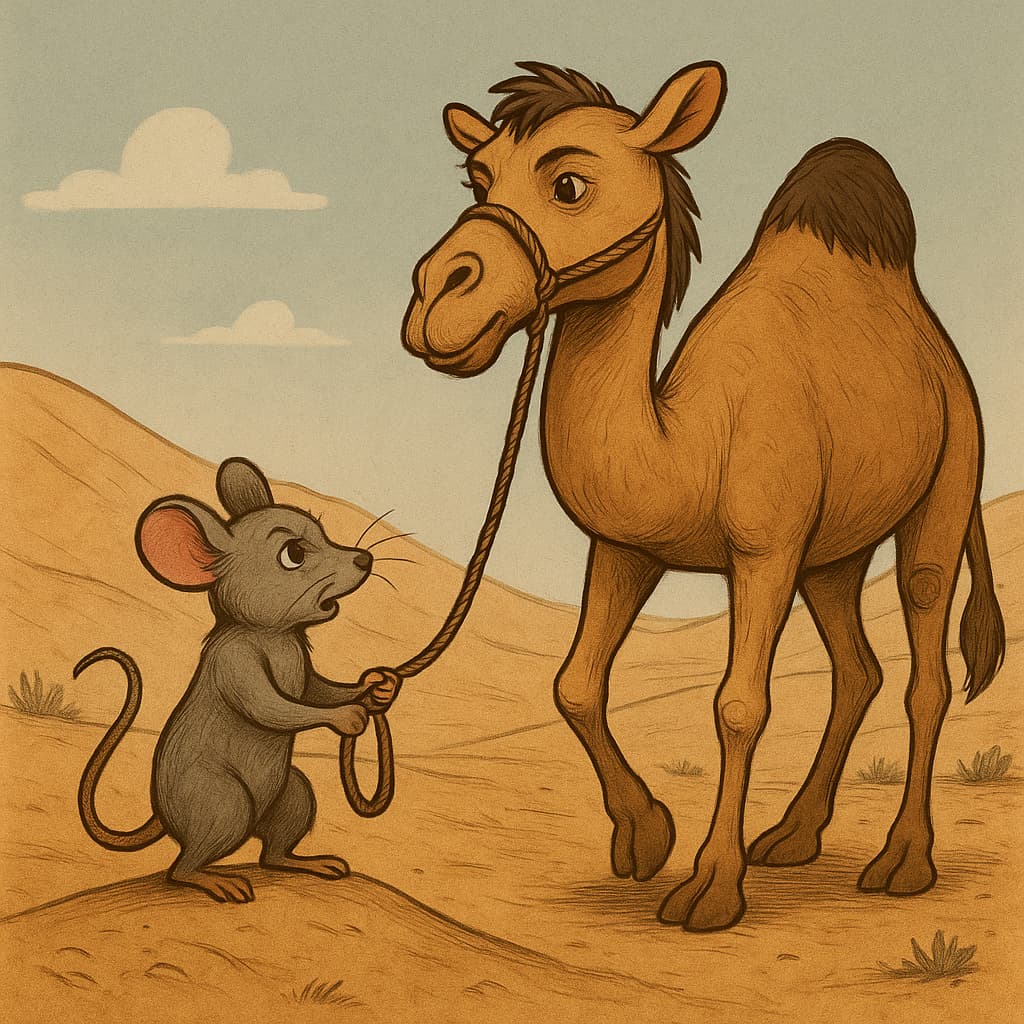
A small mouse once caught a camel’s head-rope in its paws and went off with it. Due to the nimbleness with which the camel set off, the mouse was duped into thinking himself a champion. His obvious pride struck the camel. Presently the mouse came to a great river, such as would have dismayed any… Read More
Cross Currents
The Logos and the Mind
By Charles Johnston
Why then, if the Logos be divine Light, are we so often children of darkness, at best able to say: the good I would, I do not; the evil I would not, that I do?
To begin with, is it not evident that the power thus to discern the dissonance between the good we seek and the evil we do, is already a gift of the Logos, an illumination of our minds by that ineffable Light? But the deeper mystery remains: Why are we so prone to darkness, if the Light be our Father? Why do we follow evil, if we are children of infinite Good?
Here is at once the deepest mystery of human life, and the fact of which we have, from hour to hour, the most certain experimental knowledge: namely, the mystery of free will. From one side, that problem may be forever beyond our understanding, but from another side we know all that we can possibly use regarding it, much more than we are at all inclined to use. It is exactly as with the problem of Being; from one point of view, Being is, and must ever remain, an inscrutable mystery; from another point of view we know all we need to know, since we are possessed of being, and act confidently on that possession every instant of our lives. So we have free will, and we use it continually.
We may find a workable expression of our problem, if we say that the divine Power, having given us substance and form, consciousness and will, all drawn from the divine Being itself, determined to add the final prerogative of divinity, the power of choice; not simply the power to choose between two directions, as a bird chooses one or another tree for its nest; but the power to choose, with the perception that one choice is good, and the other evil; the power to conform to the divine Will, with the power to disobey that will. This is the splendid and terrible gift with which Divinity has endowed us; and we can see that, had we not the power to disobey, the final virtue would be forever lacking from our obedience.
But if we have both the power to perceive and the power to choose, why do we habitually drag our steps? Why is it such a long matter with us, to turn from the evil we recognize as evil, and to turn to the good which we know to be good? Why are we so sluggish and reluctant in our obedience?
Time seems to enter into the equation as an almost dominating factor. But perhaps that dominance of time exists only in our imaginations; perhaps it is there, only because we think it is there. A few years ago, the followers of Darwin used to think that almost endless time entered into the change from a species to a derived species, through the addition of innumerable characters so small as to be invisible. But the followers of Mutation now think that the complete change takes but one generation, as the moss rose suddenly appeared, or the new evening primrose which started this hypothesis. It may be that time does not enter at all into either transformation; that our feeling of the innumerable divisions of time needed for any definite change in ourselves, any advance in conformity to the divine Will, is simply the expression of our divided wills, of our deep-seated reluctance really to exert ourselves.
The motto of the modern theosophical movement is “There is no religion higher than Truth”. The love of wisdom (Philo+Sophia=philosophy) is predicated upon the Search for Truth. Theosophia is not a belief system. It is rather a knowledge system and therefore Truth, Satya (Sanskrit), Veritas (Latin), Aletheia (Greek), holds sway over all. Truth is beyond formulation and cannot be encapsulated or contained. Any expression of it, no matter how faithful, is therefore incomplete. “The Truth loves questions” and therefore in theosophical circles the challenging of ideas, testing of conceptions, the questioning of assumptions is not only welcome but encouraged. The seeker wants the truth and nothing but the Truth and welcomes all ideas and challenges which clarify and refine one’s understanding.